AI knowledge base bot
for internal teams.
A custom AI chatbot trained on your internal SOPs, wiki, Notion, Confluence, Google Drive, and SharePoint. Deployed directly into Slack or Microsoft Teams so employees never leave the tool they already live in. Every query runs a permission check first — engineering docs stay in engineering, HR docs stay in HR — and every answer is audit- logged.
$500 deposit to start. $5,000 setup + $600/mo once scope is confirmed. Live in 3 to 4 weeks. Refundable if your corpus proves too sparse for retrieval and we'll show you exactly why.
Published · By Nolola
Orgs where knowledge
lives in people, not docs.
Heads of People, IT leads, VP Engineering, and RevOps at 100-500 person scaleups where senior ICs are burning focus time answering the same questions and new hires take 60+ days to hit productivity.
- Your senior engineers get DMed the same 3-4 questions every week and it's eating focus time
- New hires take 60-90 days to hit productivity because tribal knowledge lives in people's heads, not docs
- You have a wiki but nobody searches it — they Slack-DM instead because the search is bad
- Legal / security said no to org-wide ChatGPT because it doesn't respect permissions or leave an audit trail
- SMEs on your team keep threatening to quit because they're constantly interrupted by the same questions
Looking for the customer-facing version? See the customer-support RAG chatbot page or browse the micro-pages hub.
Not another SaaS tool.
A bot in the tool you already use.
Four workflows tuned for internal knowledge access. Nothing agentic by default — the bot answers with citations and hands off to a human on anything uncertain.
Slack + Microsoft Teams native answering
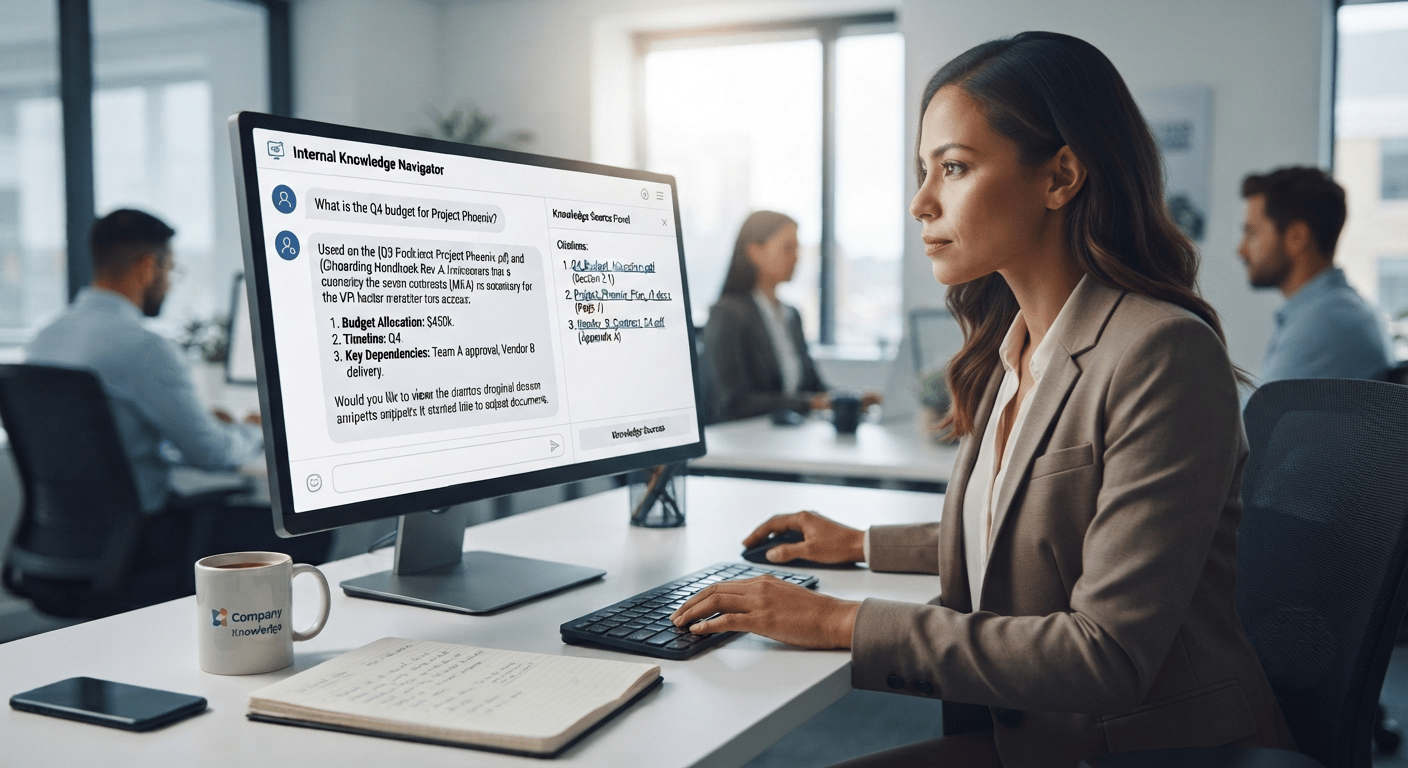
No new tool to log into. Employees @mention the bot in a shared channel or DM it directly. Answers cite the exact source doc, so a new engineer can @ask “how do we do on-call rotation?” at 11pm and get an answer sourced from your runbook instead of pinging the senior engineer.
Role-scoped retrieval (permission-aware)
Every query runs a permission check FIRST — via your Okta / Azure AD / Google Workspace groups — then retrieval is scoped to only the docs that user can already see. Engineering can't query HR's employee-relations folder. Interns can't query executive comp. This is the killer objection with legal + security and the whole reason it's not just “point ChatGPT at everything.”
New-hire onboarding accelerator
Dedicated onboarding path with a curated set of docs (company handbook, team-specific SOPs, tooling setup, glossary of internal acronyms). New hires get to first-productive-contribution measurably faster because they can ask “how do we run standup?” instead of waiting for a mentor to be free.
Docs freshness feedback loop
Every unanswered or low-confidence question is logged for KB owners. Weekly digest surfaces the top 20 things employees asked that your docs couldn't answer — so your knowledge base actually gets better every quarter instead of decaying. Bot flags stale content when a doc contradicts a newer one.
Permission-scoped retrieval
Enforced against your Okta / Azure AD / Google Workspace groups on every query. The bot doesn't create shadow access — it inherits the permissions you already have in your source systems.
Native to your source stack
Notion, Confluence, Google Drive, SharePoint, GitBook, GitHub Wiki, Guru, and Bloomfire connectors out of the box. Freshness rules deprioritize stale docs so answers reflect current state, not last quarter's.
Audit log on every question
Asker, retrieved sources, answer, confidence score, doc citations. Exportable to your SIEM / data warehouse. Governance-review-ready before your legal / security team asks for it.
Lives inside your
actual knowledge stack.
Native integrations for the doc systems, chat platforms, and identity providers internal teams actually use. If yours exposes an API or webhook, we can wire it — custom integrations are scoped and priced in the setup fee up-front, no surprise line items later.
- Slack
- Microsoft Teams
- Notion
- Confluence (Atlassian)
- Google Drive / Google Docs
- Microsoft SharePoint / OneDrive
- GitBook
- GitHub Wiki / repo docs
- Guru
- Bloomfire
- Okta / Azure AD / Google Workspace (SSO + groups)
- BambooHR / Rippling (HR docs + user directory)
- Zapier / n8n (custom source ingestion)
- OpenAI / Anthropic (model layer, your choice)
Internal RAG,
org-wide ChatGPT, or Slack DMs.
Internal RAG bot (this)
- Deliverable
- Slack + Teams native, permission-scoped retrieval, audit log, docs-freshness dashboard
- Right fit
- You want employees self-serving knowledge without leaking permissions or hallucinating policy
Org-wide ChatGPT / Claude seats
- Deliverable
- Generic LLM · no internal docs · no permissions · no audit trail
- Right fit
- You have low compliance overhead and no permission boundaries to enforce
Status quo — wiki + Slack DMs to SMEs
- Deliverable
- Slow answers, tribal knowledge, senior engineers as human search engines
- Right fit
- You're under ~30 people and everyone still knows each other
Most 100-500 person orgs recover the $5,000 setup within a quarter from senior-IC time reclaimed.
Answers in Slack.
Not DMs to senior engineers.
“We wanted org-wide LLM access but our security team blocked it — no permissions, no audit. Nolola's internal RAG bot passed the review in one meeting because it inherits our Okta groups. Engineering can't see HR's employee-relations folder even though the bot has the connectors for both. That's the whole product.”
“Our new-hire time-to-first-PR dropped from about 5 weeks to 2.5. New engineers get the answer to ‘how do we do X’ in Slack in 4 seconds instead of waiting on a mentor. My senior engineers stopped threatening to leave because they're not the human search engine anymore.”
“The freshness dashboard was the surprise. Every week we get a list of the top 20 questions our docs couldn't answer. My team of two doc writers now actually knows what to work on next quarter — before this it was ‘whatever the loudest team asked for.’”
Common questions
A public support chatbot answers customer questions from your help center and product docs. An internal AI knowledge base bot answers EMPLOYEE questions from your SOPs, wiki, Notion / Confluence / Google Drive / SharePoint, engineering runbooks, and HR handbooks. The critical difference is permission scoping: internal docs are messy trust boundaries — HR files, executive plans, engineering security runbooks all live in the same infra. An internal bot has to respect those boundaries on every single query. That's why this is a separate build from our customer-support RAG chatbot, not a config toggle.
We wire the bot into your identity provider — Okta, Azure AD, or Google Workspace — during setup. Every query does two things in sequence: (1) look up which groups the asker belongs to, (2) run retrieval only against the docs those groups can already access in your source systems. Engineering docs, HR docs, executive materials all stay in their lanes. Adding a new hire to a group in Okta immediately grants the corresponding retrieval scope. Removing them revokes it. No separate permission model to keep in sync — your existing SSO IS the permission model.
For internal knowledge it's deliberately more chatbot than agent. It retrieves, cites, and answers — it does NOT take autonomous actions on your systems by default. Optional agent behaviors get added case-by-case: “create a Jira ticket for me,” “file a PTO request,” “book a room.” Each one is scoped, permission-checked, and audit-logged. The starting posture is answer + cite, not act. Agent capabilities are additive when your security team is comfortable with them, not baked in from day one.
$500 refundable deposit to secure a kickoff slot. Once scope is confirmed at the discovery call: $5,000 one-time setup + $600/month. Setup covers corpus ingestion, embedding + retrieval tuning, SSO/group mapping, Slack or Teams deployment, and 30 days of post-launch tuning. Monthly covers hosting, model inference, quarterly retraining, and the docs-freshness dashboard. Most 100-500 person orgs pay back the setup within a quarter just from senior-engineer / senior-ops time reclaimed.
Yes, both natively. Slack tends to be a couple of days faster to install because the app-directory + slash-command story is simpler; Teams needs a bot registration + Azure app-consent flow which usually adds one working day. Either way, employees @mention or DM the bot from where they already work — no separate tool, no SSO redirect, no new tab. Some orgs deploy to both simultaneously if they have mixed populations (engineering on Slack, GTM on Teams, for example).
Your internal SOPs, team wikis, engineering runbooks, HR handbook, meeting notes, decision docs, sales playbooks, onboarding materials. Sources connect natively to Notion, Confluence, Google Drive / Docs, SharePoint / OneDrive, GitBook, GitHub Wiki, Guru, and Bloomfire. Every source respects the same permissions the user has in the source system — the bot doesn't create shadow access. Freshness rules deprioritize stale content in retrieval. When a doc changes, the index updates within an hour. Quarterly retrain is included in the monthly retainer.
Three governance guarantees, all standard: (1) permission-scoped retrieval enforced against your SSO groups — no shadow access — (2) every query is audit-logged with asker, sources retrieved, answer given, and confidence score, exportable to your SIEM or data warehouse, (3) model calls go to your chosen provider under your DPA — OpenAI enterprise, Anthropic enterprise, or an open-weights model on infra you control. NDA + DPA templates ready before kickoff. Any doc you flag as “never send to a third-party model” is honored — that source is either excluded from retrieval or answered from a local model, your call.
3 to 4 weeks. Discovery call within 2 business days of deposit. Corpus + SSO connectors + role mapping in week 1-2. Retrieval + prompt tuning + Slack or Teams deployment in week 2-3. Soft-launch to a pilot channel (usually a friendly team of 5-15) with your ops or IT lead reviewing logs. Full rollout once you're happy. 30 days of tuning included after that.
$500 deposit is fully refundable if we can't confirm scope or commit a kickoff date within 7 days. If we take on the build and your corpus turns out to be too sparse or contradictory to reach usable retrieval quality, we surface it in week 1 and refund the deposit — we don't take the setup fee if we can't make retrieval work. If you cancel post-launch, you own the corpus, the transcripts, and the prompt templates — we export on request and shut off billing the following month. No multi-year contract, no exit fee.